Clarity in Organization Life-Stages
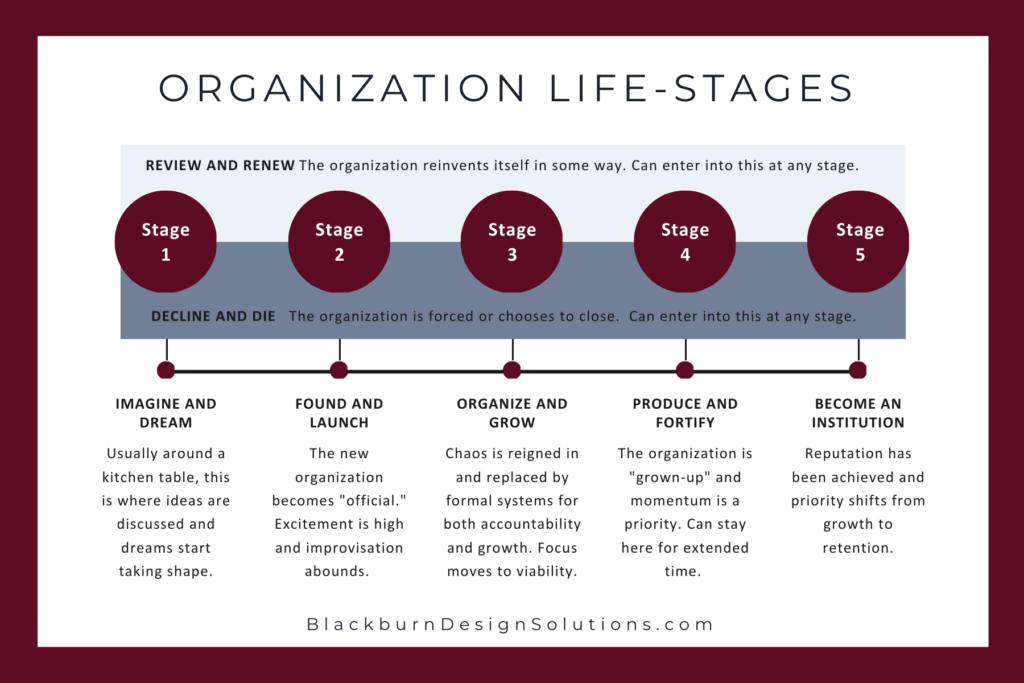
Every organization moves through stages. The work of each stage is specific. So is the clarity it requires.
There is a moment in nearly every organization’s life when something shifts. The energy that once felt like momentum starts to feel like friction. Decisions that used to be obvious take longer. People are working hard, but the results are not matching the effort. Leaders often describe it as being stuck, or as having outgrown something, without being sure what.
If you are just starting out, you may already feel it. The idea is alive, the passion is real, but something keeps the work from gaining traction. That is not a motivation problem. That is a clarity problem.
What most leaders are experiencing, whether they are six weeks in or six years in, is a gap between where the organization is in its development and what kind of clarity it actually needs right now. Not leadership advice in general. Not best practices. Clarity that is specific to this stage.
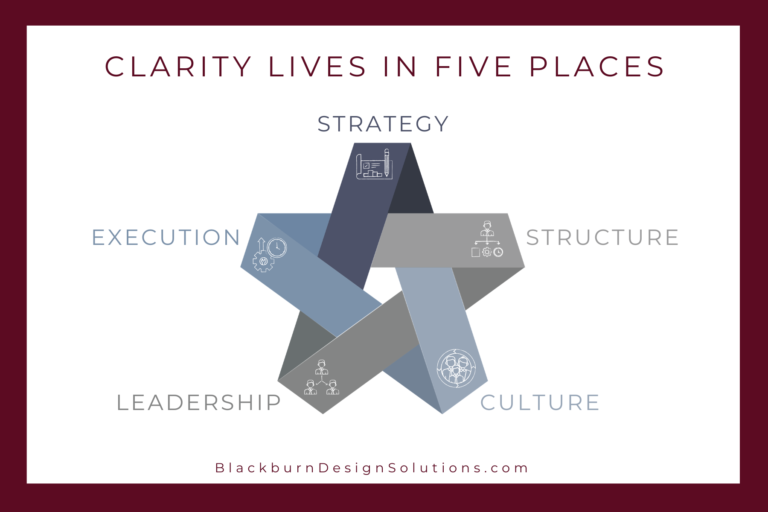
The Clarity to Capacity ArchitectureTM is organized around five dimensions of organizational health: Strategic Clarity, Structural Clarity, Cultural Architecture, Leadership Capacity, and Execution Capacity. These are not sequential. They are always present, always interdependent. What changes across the life-stages is what clarity looks like within each dimension at that particular moment.
Use the interactive tool on this page to explore the specific clarity questions and warning signs for each stage. What follows is the story behind it: what each stage actually feels like, and where organizations most often go wrong.
Stage 1: Imagine and Dream
Ideas are taking shape, but clarity has not arrived yet.
This is the kitchen table stage. The idea is alive, the conversation is electric, and the possibilities feel endless. In many ways, that is exactly as it should be. The generative energy of this stage is part of what builds organizations worth building.
But that same energy can become a trap. When everything feels possible, it is easy to avoid the harder questions: What specifically are we doing? For whom? What are we not doing? These questions can feel like they constrain the dream when, in reality, they are what make it real.
At Stage 1, clarity does not mean having all the answers. It means being willing to test your assumptions, name your direction, and lay the groundwork for a shared understanding before you have a legal entity, a team, or a budget. The organizations that skip this step often find themselves rebuilding it later, at much greater cost.
Common mistake: Treating clarity as something you will figure out once you get started. The ambiguity that feels generative at Stage 1 can calcify into confusion by Stage 2 if it is not named and addressed early.
Stage 2: Found and Launch
The organization becomes official. Excitement and improvisation abound.
Now it is real. There is a name, a structure, maybe a team, and real work to do. The excitement is high, and so is the pressure. Everything is being invented at once, and the pace of that invention makes it easy to defer the foundational questions just a little longer.
This is one of the most consequential stages for long-term organizational health, precisely because it rarely feels that way. Leaders at Stage 2 are in motion, and motion feels like progress. But culture is forming right now, whether you are designing it or not. Roles are being defined by whoever picks things up, not by intention. The founder is touching everything, and everyone is watching to understand what is actually valued here.
The clarity work of Stage 2 is not about slowing down. It is about being intentional in the middle of the speed. What do we do, and what do we not do? How do we make decisions? What are the norms we are building? These are not distractions from the launch. They are the foundation of it.
Common mistake: Assuming you can design culture and structure later, once things settle. Things rarely settle. The patterns established at Stage 2 become the baseline that everything else is built on.
Stage 3: Organize and Grow
Chaos is reined in, but formal systems are still catching up.
The organization has survived its early years and is gaining real momentum. There is a team, there is delivery, and there is growing confidence that this thing is working. The energy shifts from will it survive to how do we grow.
That shift creates its own kind of risk. Growth without structure is not sustainable. The informal systems that got you through the early stages, the shared understanding, the founder who knows everything, the workarounds that almost always work, start to break down when new people join, new complexity arrives, and the volume of decisions increases.
Stage 3 is the stage of formalization. Not bureaucracy. Not slowing down. Formalizing what has worked informally, so that it can survive at scale. Role clarity. Decision rights. Documented processes for your most critical work. Leadership that is beginning to distribute rather than concentrate.
Common mistake: Confusing growth with health. Organizations at Stage 3 can be growing yet fragile because the infrastructure needed to sustain growth has not been built. Growth without structure creates a ceiling that will eventually be felt.
Stage 4: Produce and Fortify
The organization is grown-up. Now it must be built to last.
This is the stage of credibility and results. The organization has found its stride. It is producing outcomes, earning trust, and building a reputation. Leaders often describe this stage as the one that finally feels sustainable.
It often is, for a while. But Stage 4 carries its own particular risk: resting on what is working without asking whether it is built to last. The infrastructure that supported getting here may not be sufficient for staying here. The leadership bench that served a smaller organization may not be equipped for the complexity of this one. The culture that felt strong when the team was small may be showing signs of drift now that it is larger.
The clarity work of Stage 4 is about fortification. Protecting strategic focus when opportunity multiplies. Strengthening structures that rely too heavily on individuals. Auditing whether the culture on the wall still matches the culture in the room. Building leaders who can carry complexity without the founder in the room.
Common mistake: Assuming that what got you here will keep you here. Stage 4 organizations often underinvest in the foundational work because results are good and the case for change is not obvious. The gap only becomes visible later, usually at the worst possible moment.
Stage 5: Become an Institution
Reputation is established. Priority shifts from growth to retention.
The organization has become something that transcends any single leader, initiative, or funding cycle. It has achieved a level of reputation and impact that places it in a different category. The question is no longer how do we grow. It is how do we endure.
This is the stage most organizations aspire to and fewest reach, not because they fail, but because the clarity work required to get here is ongoing and unrelenting. Institutional organizations have to do something that is genuinely difficult: hold onto what made them effective while evolving in ways that allow them to remain relevant.
At Stage 5, clarity is about legacy and transmission. Who leads next, and are they ready? How is culture passed down across generations of leadership, rather than just stated in a document? Are the systems built for production also built for retention and endurance? These are not abstract questions. They are the concrete work of institutional clarity.
Common mistake: Assuming that longevity equals stability. Institutions can lose coherence quietly, through leadership transitions that were not prepared for, cultures that diluted gradually, and strategies that were never updated because the organization was too successful to question them.
Clarity is not a destination. It is a discipline.
How Organizations Actually Move
Organizations do not progress through these stages in a straight line. A leadership transition, a significant funding loss, a rapid expansion, a crisis, any of these can shift an organization back into an earlier stage or forward before it is ready. That is not failure. That is how organizations actually develop.
What matters is recognizing where you are right now, honestly, and understanding what clarity that stage requires. Not where you were last year. Not where you plan to be. The stage you are actually in today.
This is also why clarity cannot be treated as a one-time exercise. The organizations that navigate each stage well are the ones that have built clarity as an ongoing practice, not a project they completed.
Where Do You Begin?
If any of this resonates, the starting point is simply naming where you are. Most leaders find that when they do this honestly, the clarity gaps become visible quickly.
The Strategic Clarity Session is designed for exactly this moment. In a focused, structured conversation, we identify which dimensions are most limiting your capacity right now, and what it would take to close the gap. It is the entry point to the Clarity to Capacity ArchitectureTM, and to the kind of work that actually moves organizations forward.
If you are ready to find out where your organization needs clarity most, let us start there!