Why Clarity is the Key First Step in Strategy: Most Leaders Face a Clarity Challenge, Not a Strategy Issue.
There’s a moment most leaders recognize.
The calendar is full. The team is working hard. The vision is compelling. And yet something feels stuck. Growth is happening, but it feels heavier than it should. Decisions take longer. Priorities compete. The right next move isn’t obvious.
This isn’t a motivation problem. It isn’t a talent problem. In most cases, it’s a clarity problem.
Clarity isn’t the soft work that comes after the real strategic work. It is the strategic work.
When clarity is missing about direction, priorities, and who owns what, everything downstream gets harder. Decisions get bottlenecked. Culture drifts. Good people spend energy on the wrong things. Strategy stays theoretical.
When clarity is present, the opposite is true. Teams move faster. Leaders feel less alone in their decisions. Momentum builds instead of dissipating.
What Clarity Actually Means
Clarity isn’t the same as certainty. You don’t need to know exactly how things will unfold. What you need is a clear enough picture of your direction, priorities, and constraints that you and your team can make good decisions — even in the absence of perfect information.
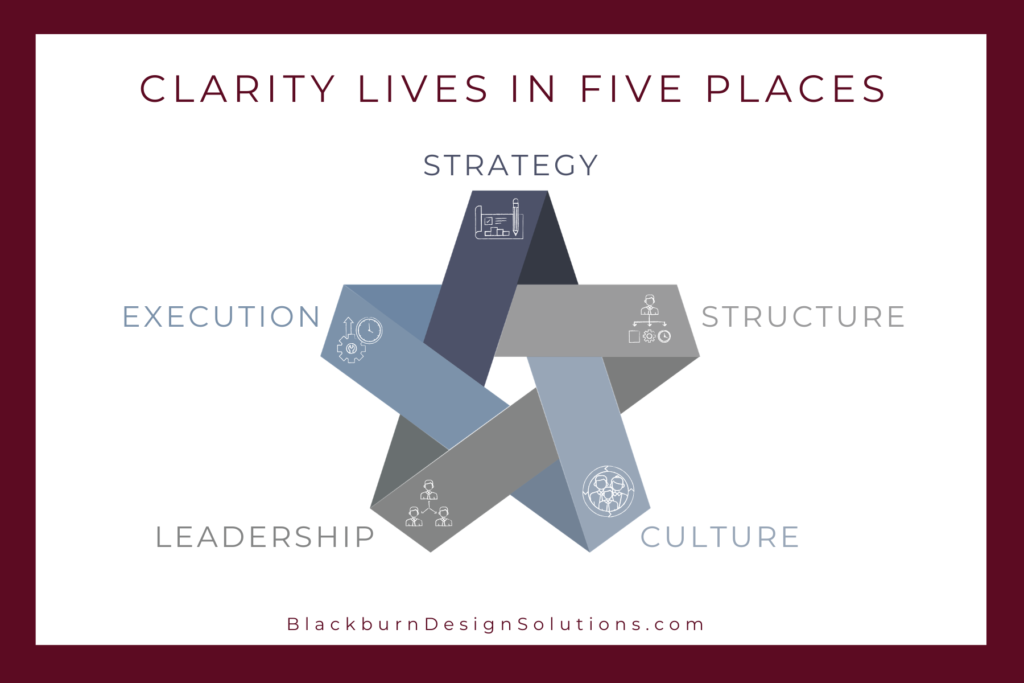
Clarity lives in five places in any growing organization:
- Strategy: Is your direction for the next 12–24 months clear and shared?
- Structure: Do people know who owns what decisions?
- Culture: Are the behaviors happening inside your organization consistent with the values you claim?
- Leadership: Is decision-making distributed in a healthy way, or is it all running through one person?
- Execution: Do your systems and rhythms support momentum, or create friction?
A gap in any one of these doesn’t just create a problem in that area. It creates pressure across all of them.
Clarity Looks Different Depending on Where You Are
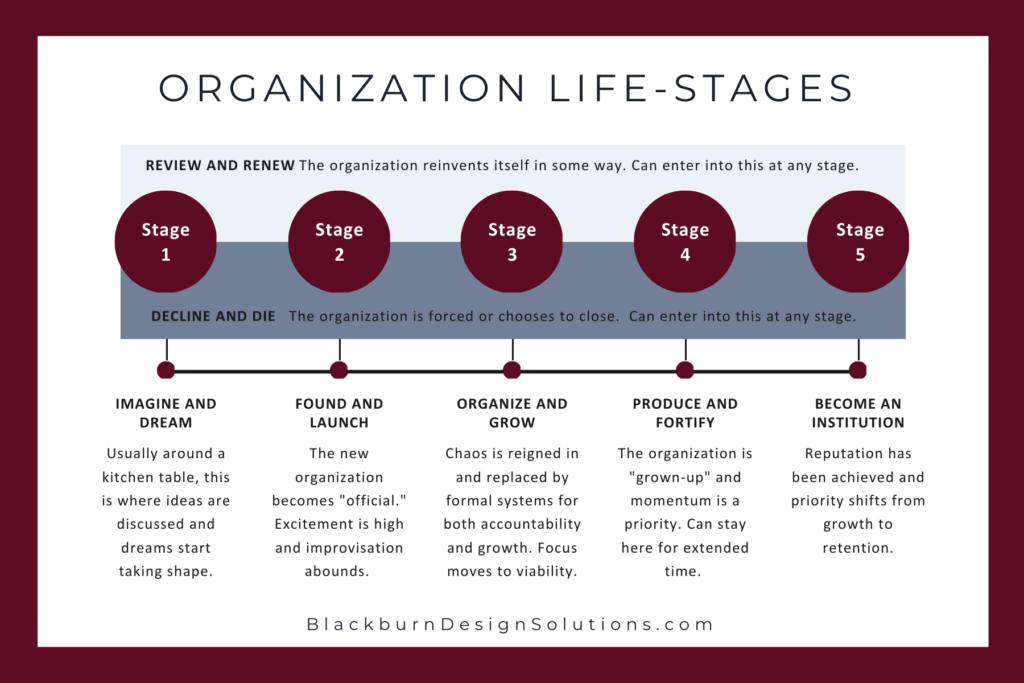
Adapted from: Simon (2001) Five Life Stages of Nonprofit Organizations · Bridges & Bridges (2016) Managing Transitions
One of the things that makes clarity work complicated is that the need for it changes as an organization evolves. What’s critical to get clear on at Stage 2 is different from what’s critical at Stage 4.
In early-stage organizations, when you’re imagining and dreaming, or just getting off the ground, clarity is mostly about direction and belief. Can you articulate what you’re building and why it matters?
In the growth stages, when you’re organizing, expanding the team, building systems, clarity shifts to structure. Who owns what? How do decisions get made? What does accountability actually look like day to day?
In more established organizations, in the produce and fortify or become an institution stages, clarity becomes about culture and leadership. Are the behaviors happening inside your organization still consistent with your original values? Has the culture kept pace with the mission?
And at any stage, there’s a fork in the road: organizations that lose clarity tend toward decline. Those who revisit and renew it, intentionally and deliberately, find their way to the next chapter.
Clarity isn’t a one-time achievement. It’s a continuous practice, and what it looks like changes as your organization grows.
The instinct, in most growth stages, is to keep moving… to hire, to launch, to build, and trust that clarity will emerge along the way. Sometimes it does. More often, the pace of growth outstrips the clarity available to support it, and leaders find themselves managing complexity they never fully designed.
The cost isn’t always obvious at first. It shows up as conversations that need to be had twice, decisions that stall, talent that underperforms, not because they aren’t capable but because they don’t know what winning looks like, and leaders who feel personally responsible for holding everything together.
Clarity now prevents costly misalignment later.
What Clarity Actually Looks Like
“Getting clear” about things isn’t a solo exercise. It’s a diagnostic process. It requires someone outside your day-to-day reality to ask the right questions, listen carefully, and reflect back what they’re hearing, not as criticism, but as orientation.
It also requires honesty about what’s actually true right now, not what should be true or what you hope is true. That combination, good questions, genuine reflection, and honest assessment, is what produces the kind of clarity that actually changes how you lead.
The output isn’t a long report. It’s a clear understanding of your primary constraints: the things that, once addressed, creates the most forward movement. And a practical first step you can take immediately.
That’s it. Focused, specific, actionable.
A Final Thought
If something feels harder than it should right now… if growth feels heavy, if decisions feel slow, if you’re doing more than you should be… that’s usually not a sign that you need to work harder.
It’s a sign you need to get clearer.
Next in this series: The 5 specific places clarity breaks down in growing organizations — and what each gap actually looks like in practice.
Ready to find your clarity?
This is exactly what the Strategic Clarity Session is designed for.
A structured 60-minute diagnostic that identifies where clarity is missing and what to strengthen first.