From Culture Shift to Mission Success: How Organizational Change Strengthens Readiness and Resilience
We believe real impact happens when culture, leadership, and communication align with purpose.
This case study provides insights and inspiration for any organization, whether military or civilian, seeking to transition from reactive problem-solving to intentional, strategic change.
The Challenge: A Strong Mission, but Inconsistent Systems
The SFRG program has a clear purpose: to connect military leaders with soldiers’ families, providing accurate information, mutual support, and timely resources. However, like many organizations, SFRGs across units were experiencing inconsistent leadership transitions, unclear communication, and uneven program support.
Surveys revealed that only 17% of respondents rated their SFRG communication positively, and 100% agreed that it was inconsistent across units. Leadership transitions too often disrupted continuity, and without a consistent framework, volunteers were frequently left to “reinvent the wheel.”
The Approach: Leading Change with Intention
Using evidence-based organizational development tools, including Kotter’s 8-Step Change Model, systems thinking, and the Army’s internal management framework, we helped guide a plan focused on:
- Professionalism: Establishing baseline standards for leadership and volunteer engagement
- Communication Competence: Building skills and tools to reduce information gaps
- Leadership Integration: Aligning leadership and management roles for program sustainability
- Leadership Integration: Aligning leadership and management roles for program sustainability
- Continuity & Consistency: Providing templates and training to ensure transitions don’t stall progress
This wasn’t a one-size-fits-all approach. It was adaptable to the needs of diverse units, from medevac commands to recruiting stations.
The Impact: Building a Resilient, Ready Culture
We reframed SFRG readiness as both a state and a process, where readiness involves having resources in place before stress, and resilience is the ability of an organization to adapt through stress.
This mindset shift leads to a renewed focus on proactive planning, resource alignment, and leadership support. Command teams obtain tools to build trust, guide volunteers, and create structures that endure beyond individual rotations.
 Welcome!
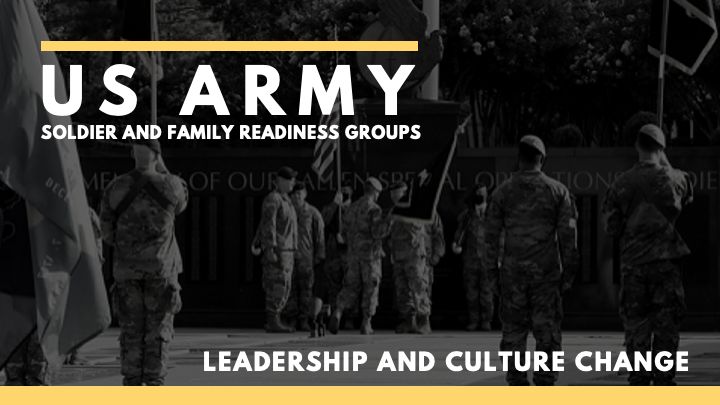
 My name is Deb Blackburn. Thank you for asking me to share some information about how we, as volunteers and staff members, can begin to improve the culture of the Soldier and Family Readiness Group program.
 I have been involved with Family Programs for many years in various paid and volunteer positions. I was a relatively unengaged new spouse before September 11, 2001, when family support looked a bit different than it does today. While the program has evolved since its inception, the benefits of linking commanders with their soldiers and families while providing a network of support and a connection to resources continue to reinforce the importance of the readiness groups.
 Over time, SFRG stakeholders have seen significant changes in family support and readiness, though the culture has remained fairly stable.
Shein defines the culture of a group as “the accumulated shared learning as it solves its internal and external problems…” This learning is a pattern or system of core values, norms, and underlying beliefs that come to be taken for granted as basic assumptions.
Stakeholders’ positive and negative experiences are scattered across a wide range, and many can be correlated to the influences of command support and leadership.
The consensus is that the 2019 “rebooting” of the SFRG provides a more structured process, driven by leadership, and presents an opportunity to build an active and resilient culture. But how exactly do we turn this chance for an improved culture into a positive change?
The world is evolving, and we must adapt. Influences, such as technology, the economy, and demographic shifts, all impact the SFRG program in various ways.
One example is the ability for people to connect in new ways. Since 2020, we have benefited from the progression of virtual meetings and communication systems, which provide a significantly improved connection for all, especially for geographically dispersed stakeholders.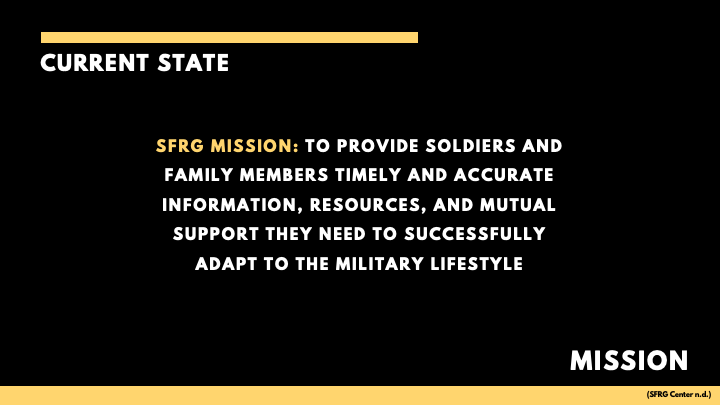 By working together to increase our focus on professionalism, communication, and change management leadership, we can improve the culture and achieve the SFRG mission for Soldiers and their families.
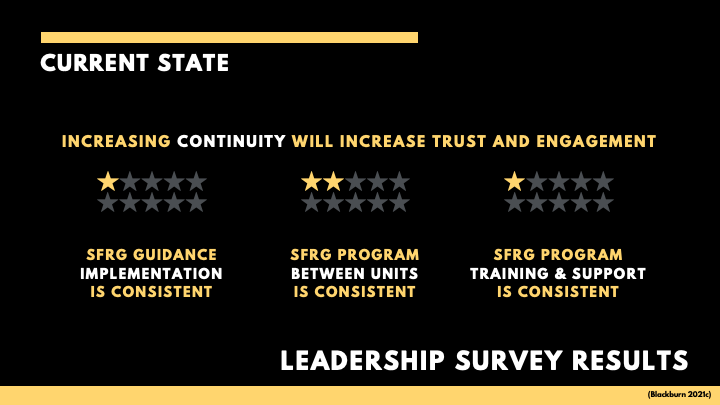 A May 2021 mixed-methods SFRG Leadership survey provides insight into current issues and demonstrates the value of improving communication and addressing necessary organizational changes.
SFRGs can have the ability to assist soldiers and their families in everyday life, as well as during transitions through different units, training, mobilizations, and deployments. This is only possible if there is continuity of process and information.
Leadership team members believe the implementation of guidance, uniformity, training, and support is inconsistent. The resulting decrease in trust and engagement negatively impacts the SFRG culture and mission.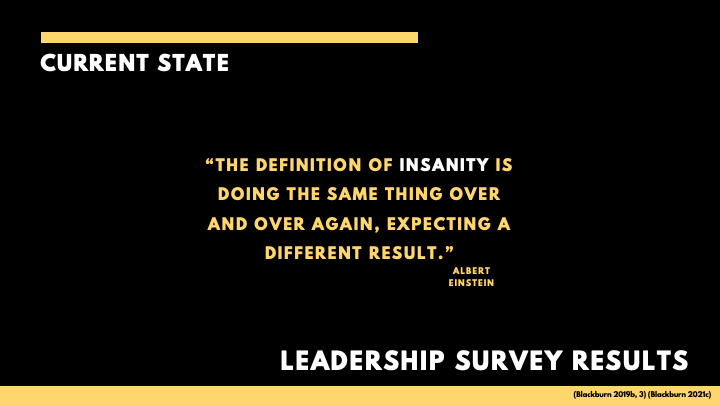 When responding to the survey, one voiced their concern about the need to do things differently: They pointed out that “Each time command teams or volunteers change, processes and expectations also change. We lose history and important information. “If leadership was consistent at a foundational level, we could provide so much more for our Soldiers and Families.”
By increasing our focus on professionalism, communication, and change management leadership, we can improve the culture and organizational readiness.
This might sound good, but what does it really mean? When thinking about communication and change in the world today, “There is growing acknowledgment that most issues cannot be solved by (one person, one department, or one organization), working in isolation.”
Everyone here believes in the mission of the SFRG, but as volunteers and staff members, we can only do so much to effect change.
As in any organization, military or civilian, changes must be supported by leadership.
The SFRG is a Commander’s program, so we must begin working directly with this group of stakeholders.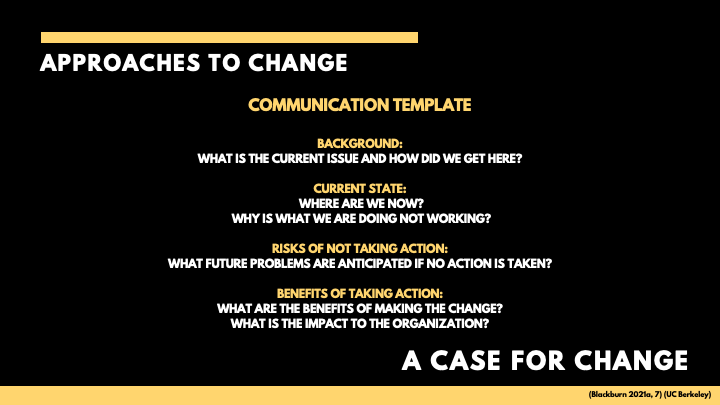 As many of us have seen, regulations can be directed from above, but if an individual or group sees a need and a benefit, they are more likely to engage and change their behavior as a result (ORL 4125, 7).
Getting commander buy-in is an essential first step to improving the culture and achieving our mission for Soldiers and their Families.
But how do we begin? We must first construct a case for change.
Crafting a plan to communicate with commanders is a crucial first step in building command engagement. This template is a helpful tool for us to use since not every unit looks the same. Recruiting commands have different needs than medevac units; however, if we can identify where we are and the benefits and risks surrounding change, we have a starting point for the conversation.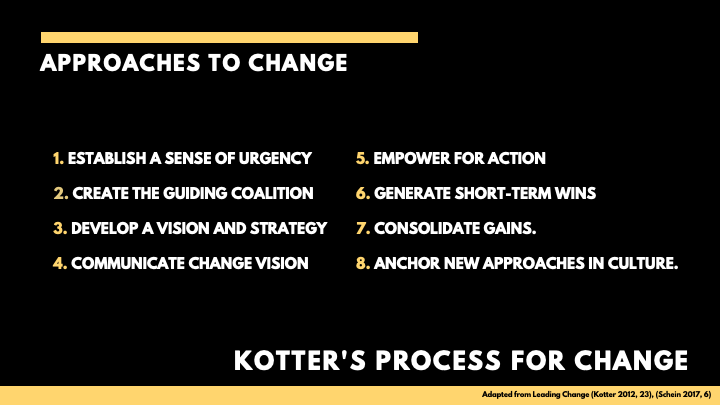 There are several approaches that we, as staff members and volunteers, can use to facilitate change.
When leading any culture change, it is helpful for everyone to understand the different stages.
The August 2021 withdrawal of the US from Afghanistan is a valuable example that demonstrates Kotter’s first step: Establishing a sense of urgency.
The rapid deployment of Soldiers to Afghanistan and the surrounding areas evolved quickly and created information and resource connection issues for families in units without as strong active SFRG in place.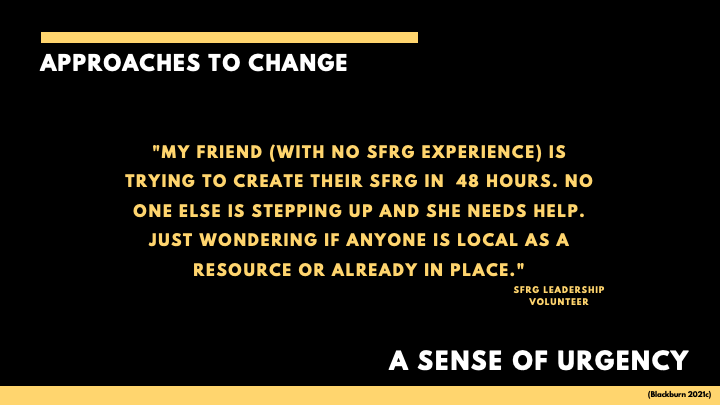 While most units involved were prepared to mobilize rapidly, some readiness groups were not equipped for such an action. Volunteers were searching for help, and family members were searching for answers.
When information and resources fail to reach family members, the soldier’s ability to concentrate on the mission is impaired, and unit readiness is compromised.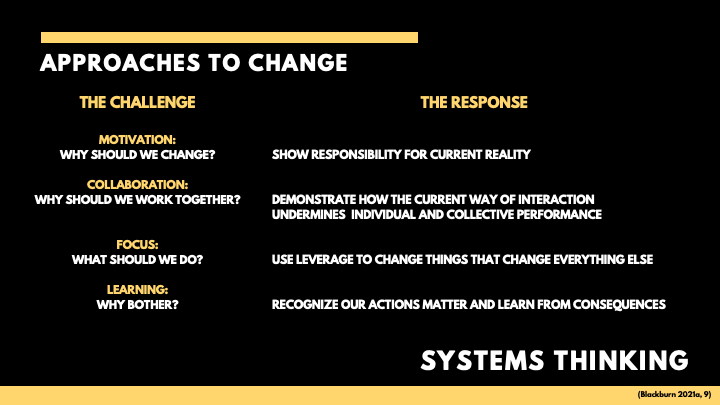 If we share examples like this with the command team, we will be one step closer to increasing motivation.
Cultivating relationships and communicating the “why” will be necessary starting points when addressing a need to change and a path forward for the unit and its SFRG program.
By learning from the challenges of past experiences, we can set the stage for a successful future. How many of you have created multiple plans for the many possibilities that Army life presents?
Sometimes it is easy to get caught up in a whirlwind of contingencies, and having an action plan to guide our path is beneficial for everyone.
If the events of 2020 and 2021 have shown us anything, it is that life is unpredictable, and being prepared is beneficial.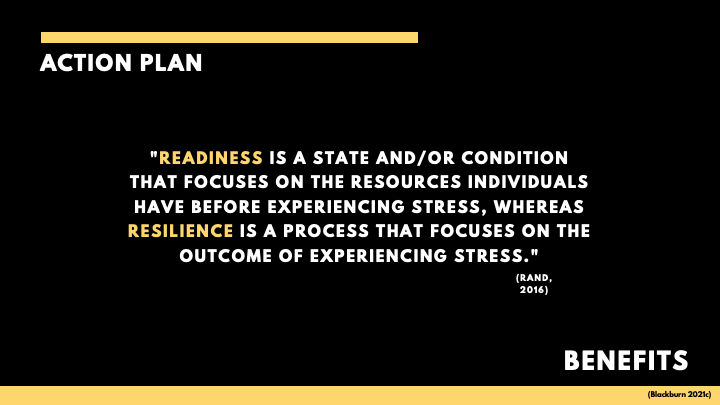 “Readiness is a state and/or condition that focuses on the resources individuals have before experiencing stress, whereas resilience is a process that focuses on the outcome of experiencing stress.”
If we want our units to be ready and resilient, we need an approach and process that SFRG teams can follow.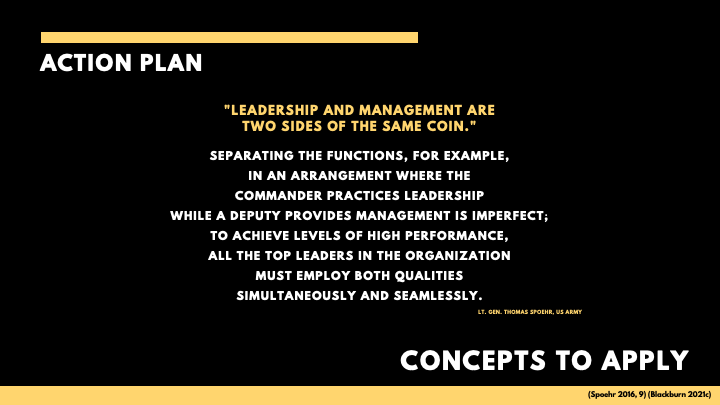 Integrating soldiers, volunteers, and staff is incredibly important when building a team. For years, the functions of SFRG leadership and management have experienced an imperfect disconnect. Many unit commanders, whose program the SFRG is, have leadership education, but little or no management education.
This is where we can help! Providing commanders with a framework to manage the SFRG program will produce a documented blueprint for successful SFRG management.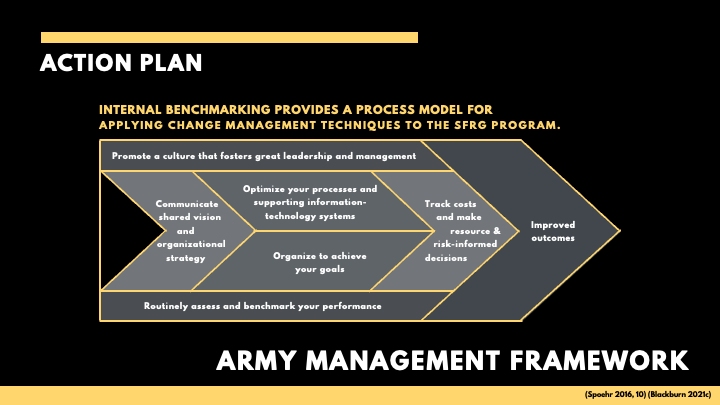 Published in 2015, Army Regulation 5–1 provides SFRG teams with “a useful framework (see figure 2) approved for the application of management techniques in Army organizations. Using this tool provides a process model for applying beneficial change techniques for the successful implementation of the 2019 changes in SFRG guidance and desired culture change.
The introduction, implementation, and integration of this framework will only be possible with effective communication, which is an area we must pay special attention to.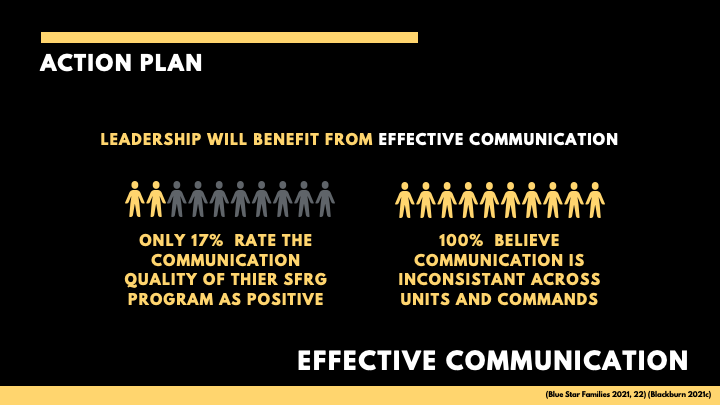 A 2021 blue star family report noted that “Because communication is a prominent factor in a positive command climate,
and there is potential for leaders to be overconfident in their communication abilities, it is imperative that military leaders at all levels understand this relationship and seek external advice regarding the efficacy of their communication patterns.”
In the 2021 leadership survey, only 17% of respondents rate their SFRG communication positively, and 100% of those believe it is inconsistent across units and commands.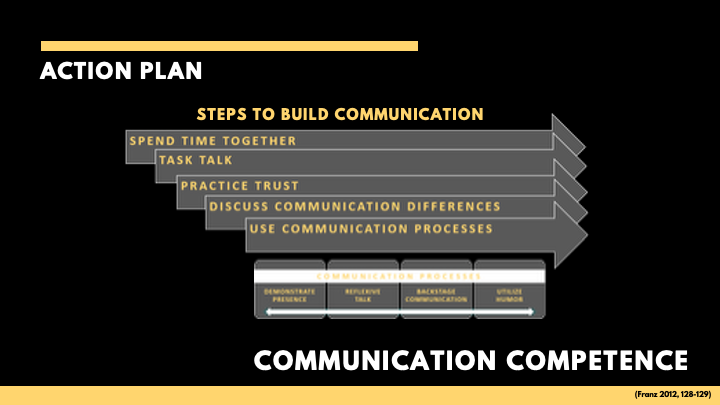 We all appreciate that military and civilian communication styles can vary widely, and it will be beneficial to develop our knowledge and resources.
Improving communication competence, including reviewing which processes to practice and which to avoid, will help us build trust and increase the engagement of command teams. The 2019 “rebooting” of the SFRG provides a more structured process, driven by leadership, and presents an opportunity to build an active and resilient culture.”
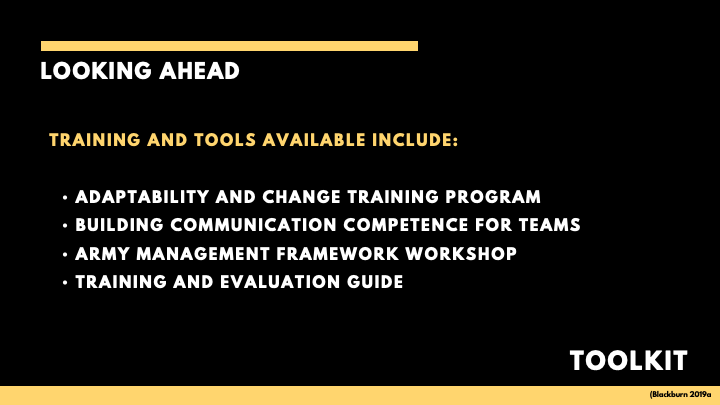 During this presentation, I have reviewed several approaches to change and the tools available to support us.
When working with our command teams, we can utilize these tools to enhance communication and continuity, thereby increasing trust and engagement.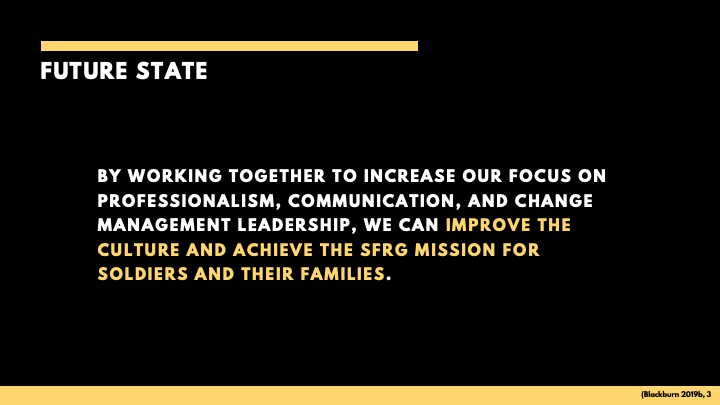 By increasing our focus on professionalism, communication, and change management leadership, we can improve the culture and achieve the SFRG mission for Soldiers and their families.
 We will provide you with a copy of these slides and links to access additional training and the toolkit.
Please let me know if you have any questions! I will be available now, and this is my contact information. Relevant citations for the information presented in each slide can be found at the bottom right corner of the image. The complete reference list is here.
A Final Thought: A Blueprint for Change in Any Organization
What worked for the SFRG can also work for your team. Whether you lead a nonprofit, government program, or social enterprise, the principles of sustainable change are universal:
“Use leverage to change things that change everything else.”
— from David Peter Stroh, Leverage for Change
Trying to find your way?
If your organization is facing transitions, cultural misalignment, or leadership turnover, let’s talk. Blackburn Design Solutions offers strategic planning, organizational development, and change leadership support tailored to purpose-driven missions.